Dining Table Shapes for Mountain Homes: Rectangle, Square, Round or Custom
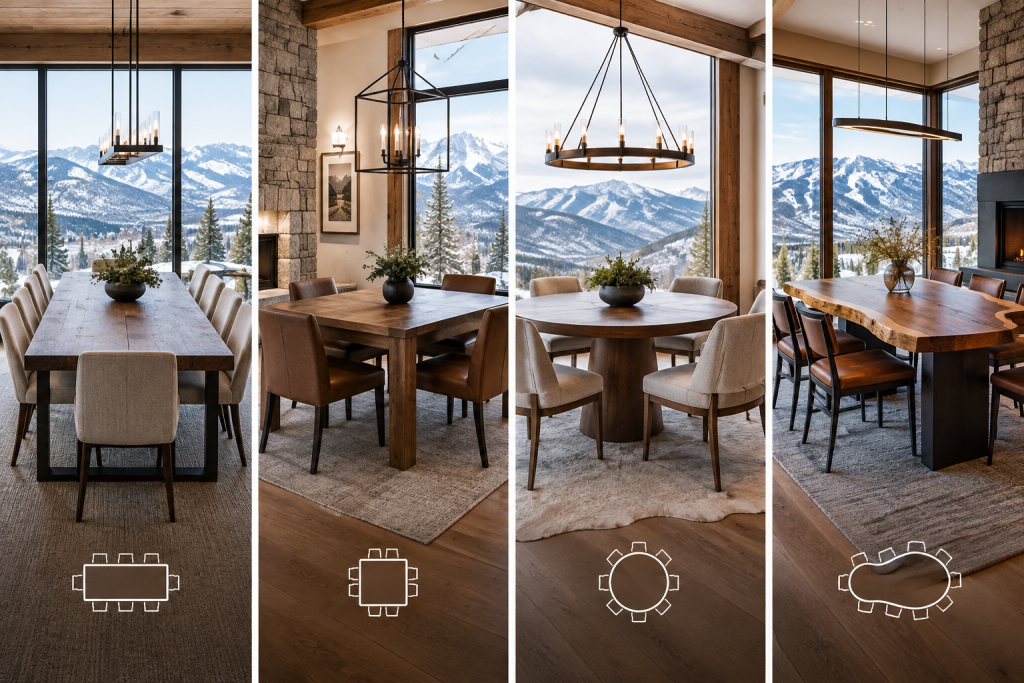
Choosing a dining table shape for a mountain home is less about following a trend and more about making the room work. The right silhouette should suit the people you expect to seat, leave enough space for chairs and walking paths, and feel proportionate to the architecture around it. In a Park City or Wasatch Back home, that may mean planning for everyday meals, holiday gatherings, visiting family or a second-home schedule that brings a full house at certain times of year.
Rectangle, square and round tables each solve different problems. A custom shape can help when the room has an unusual footprint, a difficult circulation path or a seating plan that standard furniture cannot handle comfortably. It is usually smart to settle the shape and approximate dimensions before choosing wood, finish or decorative details.
Start with the room, not the tabletop
Before comparing silhouettes, measure the dining area and note the features that will affect movement. Include door swings, openings to nearby rooms, windows, fireplaces, stairs and any route people use to reach the kitchen or living area. A table can fit on paper and still feel awkward if chairs block a passage or if someone must squeeze behind a seated guest.
Think about the clearance around the table as a working zone rather than an empty border. You need room to pull out chairs, sit down, stand up and move around the occupied table. Chair width matters, too. Wide upholstered chairs need more breathing room than narrow side chairs, and armchairs may change how many people can sit comfortably along each side.
For a second home or vacation property, consider the difference between normal use and peak use. You may want a comfortable arrangement for a small group without giving up the ability to host a larger gathering. That is where a custom-sized table, bench or carefully chosen base can be more useful than simply buying the longest table that will fit.
Rectangular dining tables: the flexible all-rounder
A rectangular table is often the easiest shape to place in a typical dining room because it follows the proportions of many rooms. Its long sides provide consistent seating, while the ends can accommodate additional guests when needed. A custom rectangular dining table can also be sized to match a particular wall, window line or open-plan boundary.
When a rectangle works well
- When the room is longer than it is wide.
- When you want flexible seating along the sides and ends.
- When the table needs to align with a kitchen island, fireplace or architectural feature.
- When everyday seating and occasional larger gatherings have different requirements.
Rectangular tables also offer plenty of design range. A farmhouse or trestle base can bring a relaxed mountain-home feel, while a modern hardwood design may look cleaner in a more restrained interior. The tabletop can be built in Douglas fir, alder, maple, white oak or black walnut through the Standard Collection, with size, finish and base style selected for the room.
The main caution is width. A longer table is not automatically a better gathering table if it becomes too wide for conversation or leaves too little circulation space. Oversized projects may call for more individualized planning, material sourcing and access review.
Square dining tables: strong proportion and shared conversation
A square dining table can suit a nearly square room or a dining area where equal sightlines matter. Everyone sits a similar distance from the center, which can make conversation feel more balanced than it does at a long table. The shape also has a confident, architectural appearance that can work well with a substantial wood top.
Square tables are most successful when the room gives them enough space on all four sides. Because the tabletop extends equally in every direction, a square design may use circulation space less efficiently in a narrow room. It can also become difficult to reach the middle if the dimensions grow too large. For that reason, the intended seating capacity and room proportions should be considered together rather than treating the square as a simple style choice.
A square table may be a good option for a compact dining room, a dedicated breakfast area or a room organized around a central light fixture. It can also make sense when the seating plan is intentionally symmetrical. If the room is almost square but not quite, a custom size may preserve the visual balance without forcing the table to crowd one wall.
Round dining tables: easier movement and inclusive seating
A round dining table removes corners, which can help people move around it and can soften a room filled with angular architecture. It also gives each guest a similar relationship to the center, making the table feel conversational and informal. In a smaller dining area, the absence of corners may make the circulation path feel less interrupted.
Round tables need careful attention to diameter. A small round table can be comfortable and efficient, but adding seats requires increasing the diameter, not simply extending one side. As the table grows, reaching shared dishes across the center may become less convenient. The room must also have enough width to provide usable space around the entire circumference.
A round top often pairs naturally with a pedestal base because a central support keeps the perimeter clear. Other base arrangements may be possible, but the placement of legs affects where chairs can go and whether guests encounter obstructions. For more on that decision, see this guide to choosing a dining table base.
Custom shapes for unusual rooms and seating plans
Sometimes the best answer is not a standard rectangle, square or circle. A custom shape may help when a room has a clipped corner, an angled wall, a tight passage or a large window that should remain visually open. It can also solve a seating plan that needs more space on one side than the other.
Custom does not have to mean complicated. It might involve adjusting the length and width of a rectangular top, softening corners, changing the proportions of a square or designing a one-of-a-kind outline around an architectural constraint. Specialty projects may include unusual dimensions, distinctive slab character, unusual bases or more individualized material sourcing.
Live-edge slabs and epoxy river designs create another kind of custom decision. Their natural edges and character can become the visual focus, but the usable seating area still needs to be planned. A live edge should not be allowed to reduce chair clearance or make one place setting noticeably less practical than the others. In a mountain-home interior, the organic outline can be striking; it just needs to work as furniture first.
How the base changes the shape decision
The tabletop outline and the base should be planned together. Four legs are familiar and can suit many rectangular designs, but their placement may limit where chairs can be tucked in. A trestle base can support a farmhouse or traditional look, though the location of the trestles matters for feet and chair legs. A pedestal can keep the perimeter open, which is particularly useful for round tables or flexible seating.
Base placement also matters when adding a bench. A bench may provide flexible seating along one side of a rectangular table, but it needs enough room to slide in and out. It should not turn a main walkway into a furniture obstacle. The same principle applies to tables planned for large family gatherings: capacity is useful only when the room can support the movement that comes with it.
Choose the shape before choosing the wood
Once the silhouette and dimensions are reasonably clear, wood and finish decisions become easier. Douglas fir may support a more relaxed, rustic direction; maple can read differently from the more pronounced character of white oak or black walnut. Alder, white oak and walnut each bring their own color and grain presence. None is universally right for every room, so compare appearance, design compatibility and the overall specification together.
Park City Tables offers both a Standard Collection with established designs and more readily available lumber, and a Specialty Collection for live-edge slabs, epoxy river tables, oversized tables and unusual builds. You can review custom table wood options after narrowing the size and shape. That order of decisions helps prevent a beautiful material from driving a layout that does not function.
A practical way to narrow your options
- Measure the room, including doors, openings and likely walking routes.
- Choose the number of people you want to seat comfortably on ordinary days and during gatherings.
- Mark the proposed tabletop footprint on the floor with painter’s tape or temporary furniture.
- Test chair positions, including any armchairs or benches you expect to use.
- Compare rectangle, square and round options against the room’s proportions.
- Ask whether a custom dimension or shape would improve circulation or seating.
- Only then compare wood species, finish, base style and optional engraving.
If the table will go into a second home, share room photographs and measurements early. Large furniture may also need to be planned around door widths, stairways, elevators and turns. Table delivery and setup can include bringing the table into the intended room, assembling or attaching the base when needed, leveling and final placement.
Which dining table shape is right for your mountain home?
Choose a rectangle when you want adaptable seating and the room has a longer profile. Consider a square when the room and seating plan are balanced on all sides. Look at a round table when corner-free circulation and shared conversation are priorities. Choose a custom shape when the room, architecture or seating needs do not cooperate with standard proportions.
The goal is not to select the most dramatic silhouette. It is to choose a table that lets people sit comfortably, move naturally and gather without the room feeling crowded. Park City Tables creates built-to-order and specialty dining tables for Park City and Utah mountain homes, with options for size, wood, finish, base style and custom details.
To begin, send a room photo, approximate dimensions, the number of people you would like to seat and examples of tables you like. Park City Tables can help narrow the size, shape, wood, style, base, finish and options. Request a custom table quote or call 435-200-4982.