
What Size Dining Table Do You Need for 8, 10 or 12 Thanksgiving Guests?
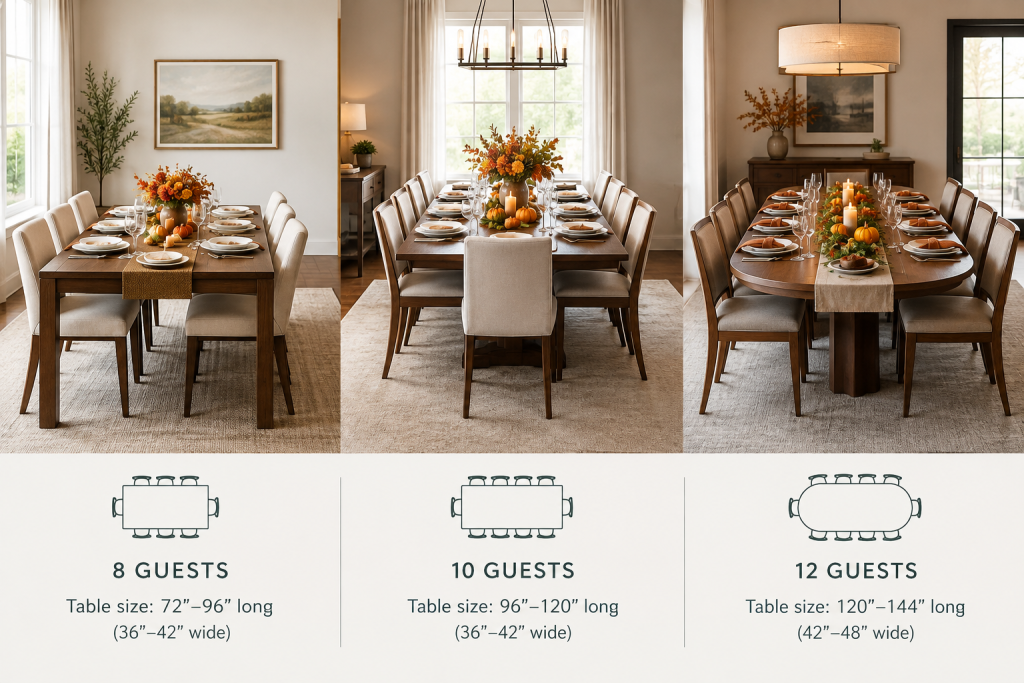
Wondering what size dining table you need for 8, 10 or 12 people? Guest count is a useful starting point, but it is not the whole answer. The right table also depends on chair width, the table’s shape, leg or base placement, serving dishes and the amount of space people need to move around it.
For Thanksgiving, that last part matters. A table that technically seats twelve may feel crowded once you add wider dining chairs, children’s places, platters and the person who keeps getting up to check the potatoes. A little planning before you order can make the room much more comfortable.
The dimensions below are approximate planning ranges rather than rigid rules. They can help you establish a target size, then refine it around your room and the way your household actually hosts.
Start with seating space, not just the guest count
A practical starting point is to allow roughly 24 inches of table edge per adult diner. That gives each person usable elbow room without making the table unnecessarily enormous.
- 8 people: approximately 72 to 84 inches long
- 10 people: approximately 96 to 108 inches long
- 12 people: approximately 108 to 120 inches long
These ranges generally assume a rectangular table with people seated along the long sides and, when appropriate, at the ends. A narrower chair may make the compact end of a range workable. Upholstered armchairs or chairs with broad arms may push you toward the longer option.
Width matters, too. A dining table around 36 to 42 inches wide often gives diners enough room for place settings while leaving some space in the center for serving bowls. A wider table can look impressive in a large mountain-home dining room, but it may make conversation and passing dishes less convenient. If the table is intended mainly for large gatherings, consider where serving pieces will go rather than assuming more width always equals more comfort.
What size table works for 8 people?
For eight guests, a table around 6 to 7 feet long is a common planning target. A 6-foot table may work well when chairs are relatively compact and the ends are used. Moving closer to 7 feet gives you more flexibility for wider chairs, larger place settings or a little extra breathing room.
An 8-person table is often a good fit for a household that hosts occasionally but does not need a permanent oversized gathering table. It can still feel substantial, especially when paired with a trestle, farmhouse or modern hardwood base that suits the room.
Before settling on the shortest possible length, measure your actual chairs. Two small side chairs can occupy much less space than two upholstered armchairs. Also check whether the table base interferes with feet or prevents a chair from sliding into the end position. A tabletop may have enough length on paper while the base quietly steals usable seating.
What size table works for 10 people?
For ten guests, plan on approximately 8 to 9 feet of length. An 8-foot table can be suitable for a moderately sized dining area, while a 9-foot table provides more room for comfortable spacing and broader seating.
This is often the point where a standard dining table starts to feel limiting. If your Thanksgiving gatherings regularly include ten adults, occasional extra guests or generous serving dishes, a custom-sized table can help you choose the actual balance between length, width and room clearance instead of settling for whatever size is available.
A rectangular table remains the most space-efficient choice for ten in many rooms. An oval table can soften the visual footprint because it has rounded ends, although its usable seating depends on the curve and the width of the ends. A round table can encourage conversation, but the diameter required for ten people may take up more floor area than expected.
What size table works for 12 people?
For twelve guests, approximately 9 to 10 feet is a sensible initial range. Some layouts may require a longer table, particularly when the chairs are wide or when you want generous space between place settings. A 10-foot table can become a real gathering piece, but it should be selected only after measuring the room and the route used to reach each seat.
At this size, the table’s proportions and base design become especially important. A very long, narrow tabletop may look stretched, while an extremely wide one can make the center difficult to reach. Trestle bases can create a strong farmhouse character and may provide useful flexibility for seating, but the exact base placement still needs to be considered. A pedestal or another custom base may change how chairs fit around the ends.
For oversized tables, access belongs in the early conversation—not after the table is built. Door widths, stairways, elevators and tight turns can affect how a large piece enters the home. Park City Tables can plan large tables around those restrictions as part of the design process.
How much room should you leave around the table?
Measure the room from the finished walls, cabinetry and other fixed features—not simply from wall to wall. As a general planning target, leave about 36 inches between the table edge and the nearest wall or obstruction. That space allows a chair to be pulled out and gives people a reasonable path behind seated guests.
If the dining area is also a main walkway, more clearance may be helpful. If one side of the table sits against a wall and is rarely used, the layout may work with less space there, but you should not count that side as fully accessible seating.
Use painter’s tape to mark the proposed tabletop on the floor. Add another outline for pulled-out chairs. Then walk around it while carrying an imaginary platter—an oddly effective test. Open nearby doors, move through the room and check whether the route to the kitchen still works when every chair is occupied.
Rectangular, round, oval or square?
Rectangular tables
Rectangular tables are usually the easiest shape for fitting a specific number of guests into a defined room. They work especially well for long dining areas and can be designed in farmhouse, trestle or modern hardwood styles.
Oval tables
Oval tables offer a softer outline and remove sharp corners from the ends. Their seating capacity depends on the overall length and the curve, so use the actual tabletop dimensions rather than relying on a label such as “10-person table.”
Round tables
Round tables keep everyone facing toward the center, which can be appealing for conversation. However, the diameter grows quickly as you add seats. Make a floor template before choosing a large round table, and consider how far diners will need to reach for serving dishes.
Square tables
Square tables can suit a square dining room and create an even arrangement around the center. For larger groups, though, the required footprint may be substantial. They are worth considering when the room proportions support them, not simply because the seating number sounds convenient.
Chair width and table bases can change the answer
Most seating guides assume a fairly standard chair width. Your furniture may not cooperate with that assumption—and that is fine. Measure the widest part of each chair, including arms, then calculate how many can fit along each side without bumping into one another.
Also look at how the base occupies the underside of the table. Four corner legs can limit where chairs go. A trestle, pedestal or custom base may offer a different seating pattern, but it still needs enough room for knees and feet. The usable seating count should be based on the complete design, not the tabletop alone.
Benches can make seating more flexible, especially for children or less formal gatherings. They still need enough length and clearance, and they should coordinate with the table height and base. A custom bench can be planned alongside the table rather than added as an afterthought.
Build in room for Thanksgiving serving
Ask how you serve the meal. If platters and bowls sit on the table, reserve center space for them. If you use a sideboard or kitchen island, the table may need less depth. If guests serve themselves from the table, extra width or a little more length can make a meaningful difference.
Think about the everyday version of the room, too. A table sized for twelve may be perfect for holiday gatherings but visually heavy if the home usually seats four. Extending tables, benches or a carefully chosen custom size can help balance everyday use with occasional hosting.
When custom sizing makes sense
Custom sizing is useful when the room falls between standard dimensions, when the chairs are unusually wide, or when you want to coordinate the table with a specific architectural feature. It also gives you a chance to choose the wood, finish, base style and proportions together.
Park City Tables creates built-to-order dining tables for Park City and Utah mountain homes. Standard Collection choices include Douglas fir, alder, maple, white oak and black walnut, with established farmhouse, trestle and modern hardwood designs. Specialty projects can include live-edge slabs, epoxy river details, oversized dimensions and more unusual bases.
Material choice affects the look and budget, so it is worth comparing grain, color, character and finish rather than searching for one universally “best” wood. You can review custom table wood options as you narrow your direction. For more distinctive proportions or slab character, see the specialty custom tables collection.
A simple decision framework
- Write down the number of adults, children and occasional extra guests you want to seat.
- Measure your chairs, including arms and the space needed to pull them out.
- Mark possible tabletop sizes on the floor with painter’s tape.
- Check roughly 36 inches of circulation where people need to walk or pull out chairs.
- Decide whether you need room for serving dishes on the tabletop.
- Compare rectangular, oval, round and square layouts.
- Review base placement, access restrictions and whether a bench would help.
Then send a room photo, approximate dimensions, desired seating capacity and examples of tables you like. Park City Tables can help narrow the size, wood, style, base, finish and options through the custom table ordering process. Delivery and in-home setup can also be planned around access conditions; learn more about table delivery and setup.
To request a custom quote, call 435-200-4982 or contact Park City Tables through ParkCityTables.com. A good Thanksgiving table should fit the guest list, of course—but it should also fit the room, the chairs and the way your household gathers. That is where the measuring tape earns its keep.