
Farmhouse vs Modern Dining Tables for Park City Mountain Interiors
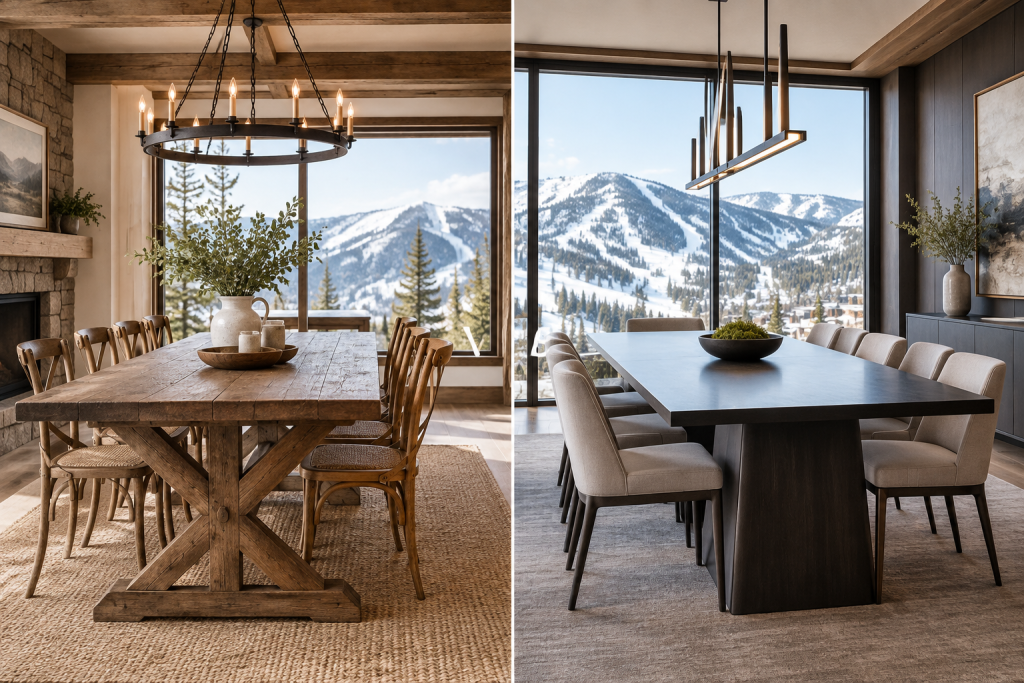
Choosing between a farmhouse and modern dining table for a Park City mountain home comes down to more than a style label. The right direction depends on how you want the room to feel, how many people you need to seat, and how the table should relate to the home’s wood, stone, lighting, and architecture.
This guide compares the silhouettes, bases, wood choices, proportions, and planning considerations that distinguish the two approaches. By the end, you should be able to describe a clearer custom table brief—or identify the questions to resolve before choosing one.
Both directions can work beautifully in a mountain home, ski property or second home. The useful part is getting specific about the design vocabulary: tabletop shape, edge profile, base style, wood character, seating needs and the amount of visual weight the room can handle. Once those decisions are clear, a custom table brief becomes much easier to write—and much less likely to sound like “make it rustic, but not too rustic.”
What makes a farmhouse dining table feel farmhouse?
A farmhouse table typically has a strong sense of structure and presence. It may use a thick-looking top, a trestle base, substantial legs or a straightforward silhouette that feels made for long meals and crowded holidays. The design usually emphasizes warmth, practicality and visible wood character rather than delicate lines.
That doesn’t mean every farmhouse table needs to look old-fashioned. A simple Douglas fir, alder or white oak top can feel current when paired with a restrained finish and carefully proportioned base. Likewise, a trestle table can be tailored to a more refined mountain interior through its width, edge treatment and finish.
Farmhouse design vocabulary
- Broad, visually substantial tabletop
- Trestle or sturdy end-based construction
- Visible grain and natural variation
- Warm or lightly weathered finish possibilities
- Comfortable compatibility with benches
- A welcoming, informal feeling suited to group meals
Farmhouse is often a good direction when the dining area is meant to be the social anchor of the home. It can also make sense when you want the table to feel connected to natural materials, exposed beams, stone, leather, wool or other familiar mountain-home elements.
What defines a modern hardwood dining table?
Modern dining tables tend to rely on clarity. The top may have a slimmer visual profile, a crisp rectangular shape, a clean edge or a base that appears lighter and more open. The goal isn’t necessarily minimalism in the strictest sense. It’s a controlled composition in which the wood, base and surrounding room have room to breathe.
A modern hardwood table can still be warm. White oak, maple, alder or black walnut can bring plenty of texture and depth without requiring a rustic silhouette. In a mountain interior, that contrast can be especially useful: natural wood keeps the table from feeling cold, while a cleaner base keeps the room from becoming visually heavy.
Modern design vocabulary
- Simple rectangular or softened-rectangle silhouette
- Clean lines and a restrained edge profile
- Pedestal, sled, steel-inspired or geometric base directions
- More selective use of grain and finish contrast
- Open space beneath the table
- A quieter relationship with bold lighting, views or architectural details
Modern may be the better starting point when the room already has strong visual features, such as dramatic windows, a sculptural light fixture, contemporary cabinetry or a distinctive fireplace. The table can provide substance without competing with everything else.
Farmhouse vs modern: compare the silhouette first
Before choosing a wood species or finish, look at the table’s outline. A farmhouse table usually reads as grounded and sturdy. A modern table often reads as more streamlined. That difference affects how much space the table appears to occupy, even when the actual dimensions are identical.
For example, two eight-foot tables can seat a similar number of people but feel very different in the room. A thick top with a broad trestle base may become the visual centerpiece. A slimmer top with a more open base may allow chairs, flooring and surrounding furnishings to remain more visible.
Consider these questions:
- Do you want the table to be the main focal point or a quieter part of the composition?
- Will people sit at the ends, and will the base interfere with their legs?
- Would benches help with flexible seating?
- Does the room need more visual light beneath the table?
- Are nearby furnishings traditional, transitional, contemporary or mixed?
These questions are more useful than choosing a style based only on a photograph. Inspiration images are helpful, but proportions and base placement determine whether the idea works in your room.
Base styles change the whole personality
The base is where farmhouse and modern directions often separate most clearly. A trestle base gives a table a strong, grounded stance and can make it easier to slide a bench along one side. It also needs careful planning around chair legs and foot placement.
Leg-based tables can feel familiar and flexible, but the spacing matters. A base positioned too close to the ends may limit seating. A base positioned too far inward may reduce comfortable legroom. Pedestal or central bases can create a clean look and make it easier to place chairs around the perimeter, though their shape and footprint still need to suit the room.
For a modern table, the base might be deliberately understated or become a geometric feature. For a farmhouse table, it may be one of the main visual statements. Neither approach is automatically better; the right choice depends on seating, room clearance and the amount of structure you want to see.
Choosing wood for a Park City mountain interior
Wood choice can push either style in several directions. Park City Tables’ Standard Collection includes Douglas fir, alder, maple, white oak and black walnut. These choices offer different combinations of color, grain character and visual weight.
Douglas fir can support a relaxed farmhouse direction when its grain and warmth are allowed to remain visible. Alder can offer a comparatively understated foundation for either a casual or transitional table. Maple tends to suit a cleaner look, while white oak can bridge rustic and modern design depending on the finish and base. Black walnut usually brings deeper color and a more formal, high-contrast presence.
There is no universally best wood. Think about how the table should relate to flooring, cabinetry, chairs and nearby stone. A lighter wood may keep a darker room from feeling too dense. A deeper wood may give a large, open room more visual anchor. The finish should support that goal rather than obscure the character you selected.
For a closer look at the tradeoffs, review these custom table wood options before narrowing your brief.
Proportion matters more than the style label
A table can be “modern” or “farmhouse” and still be wrong for the room if its dimensions are off. Start with the number of people you want to seat, then account for chair width, serving space and clearance around the table. A beautiful top becomes less useful when chairs cannot pull out comfortably or when the route to the kitchen turns into a furniture obstacle course.
Measure doorways, stairways, elevators and other access points as well as the dining area itself. This is particularly important for large tables in mountain homes, where the intended room may be upstairs or reached through a narrow entry. The design should be planned around the delivery route, not just the final photograph.
Park City Tables can use a room photo, approximate dimensions, desired seating capacity and examples of tables you like to begin the design conversation. The planning process can often be handled remotely, which is useful for second-home owners, designers and property teams coordinating from another location.
If you are comparing six-, eight- and ten-foot options, the guide to built-to-order dining tables can help you move from a general style preference to a more specific size and configuration.
When a farmhouse or modern table should become more distinctive
Some rooms call for a straightforward table from the Standard Collection. Those designs use established styles and more readily available lumber for a simpler, more predictable custom-table process. Standard options may include farmhouse, trestle and modern hardwood designs.
Other rooms need something more individualized. A live-edge slab, unusual dimension, distinctive wood character, epoxy detail or unusual base may lead toward a Specialty Collection project. A live-edge table can bring a strong natural outline to a mountain interior, while a clear or colored epoxy river detail can introduce a deliberate accent.
Those choices require more planning because the appropriate slab or hardwood may need to be sourced specifically for the project. Explore specialty custom tables if the room calls for a one-of-a-kind direction rather than a variation on an established silhouette.
Turn your preference into a custom-table brief
Once you know whether you lean farmhouse or modern, write down the details that will keep the project focused:
- Room: Include a photo, approximate dimensions and the intended location.
- Seating: State the everyday and occasional number of diners.
- Silhouette: Describe the desired visual weight, top shape and edge profile.
- Base: Mention trestle, legs, pedestal or another direction, while staying open to proportion advice.
- Wood: List preferred species and whether you want prominent or restrained grain.
- Finish: Explain whether the table should feel light, warm, natural, dark or more contemporary.
- Details: Note benches, engraving, epoxy or other personalization.
- Access: Flag stairs, narrow doors, elevators or other delivery considerations early.
Custom engraving can add a personal layer to either style. A family name, meaningful date, coordinates, monogram or short inscription might be placed on the tabletop, apron, base, end or underside, depending on the design. A subtle underside engraving can keep a modern table especially clean, while a visible end or apron detail may suit a more expressive farmhouse table.
Which direction is right for your Park City home?
Choose farmhouse if you want a table that feels grounded, generous and ready for long gatherings. Choose modern if you prefer cleaner lines, more open space and a controlled relationship with the rest of the room. Choose a blended direction if you like the warmth of a substantial wood top but want a simpler base and finish.
The most successful choice is usually the one that fits the room, the people using it and the way the home is actually occupied. A table for a primary residence may need a different balance than one for a second home, vacation property or large family gathering space.
To begin, request a custom quote from Park City Tables. Send a photo of your room, approximate dimensions, the number of people you would like to seat and examples of tables you like. The team can help narrow the size, wood, style, base, finish and options. Call 435-200-4982 or request a custom table quote through ParkCityTables.com.
Farmhouse vs modern: use the room to make the decision
Farmhouse tables usually feel grounded, substantial, and welcoming. Modern tables generally feel cleaner, quieter, and more open. Neither direction is automatically better for a Park City interior. The stronger choice is the one that supports the room’s existing visual weight and the way people will use the table.
Choose farmhouse as a starting point when the dining area should act as a social anchor alongside exposed beams, stone, leather, wool, or other familiar mountain-home materials. Choose modern when dramatic windows, contemporary cabinetry, a sculptural light fixture, or a distinctive fireplace already provide strong visual features.
A practical comparison of farmhouse and modern tables
- Farmhouse: broad or substantial-looking top, trestle or sturdy end-based construction, visible grain, natural variation, and a welcoming relationship with benches.
- Modern: cleaner lines, a restrained edge profile, a slimmer visual profile, more open space beneath the table, and a quieter relationship with bold lighting or architectural details.
- Either direction: can use warm hardwoods and can be tailored through dimensions, edge treatment, base placement, and finish.
Look at the outline before choosing a wood species or finish. Two eight-foot tables can seat a similar number of people but feel very different when one has a thick top and broad trestle base while the other has a slimmer top and open base.
Ask these questions before choosing a silhouette
- Should the table be the main focal point or a quieter part of the composition?
- Will people sit at the ends, and will the base interfere with their legs?
- Would benches help with flexible seating?
- Does the room need more visual light beneath the table?
- Are nearby furnishings traditional, transitional, contemporary, or mixed?
Inspiration images are helpful, but proportions and base placement determine whether the idea works in your room.
Choose wood and finish to control visual weight
Park City Tables’ Standard Collection includes Douglas fir, alder, maple, white oak, and black walnut. Douglas fir can support a relaxed farmhouse direction, while maple can suit a cleaner look. White oak can bridge rustic and modern design depending on the finish and base. Black walnut can bring deeper color and a more formal, high-contrast presence.
There is no universally best wood. Consider how the table will relate to flooring, cabinetry, chairs, and nearby stone. A lighter wood may keep a darker room from feeling too dense, while a deeper wood may give a large, open room more visual anchor. For additional comparison, review the custom table wood options.
The style label is only the starting point
Choosing farmhouse or modern is useful only when it helps clarify the table’s silhouette, visual weight, seating arrangement, wood character, and relationship to the rest of the room. A table can fit either category and still be wrong if its proportions or base placement do not work in the space.
Choose the direction that supports the room
Use farmhouse design when you want a grounded social anchor with visible wood character, substantial structure, and comfortable compatibility with benches. Use modern design when the room already has strong architectural features and needs a cleaner, more open composition. A custom brief can combine elements of both without forcing the table into a rigid label.
Turn a style preference into a workable table brief
- Define the number of people you need to seat.
- Choose a silhouette and base that preserve legroom and circulation.
- Select a wood species and finish that balance nearby flooring, cabinetry, chairs, and stone.
- Measure the delivery route as well as the dining room.
Start with the information that shapes the design
Park City Tables can use a room photo, approximate dimensions, desired seating capacity, and examples of tables you like to begin the design conversation. The planning process can often be handled remotely, which is useful for second-home owners, designers, and property teams coordinating from another location.
What if you are not sure which direction fits?
You do not need to settle the farmhouse-versus-modern question before asking for guidance. Comparing the room’s proportions, seating needs, access points, wood options, and surrounding materials can reveal whether a Standard Collection direction is appropriate or whether a more individualized Specialty Collection project makes sense.
Discuss your Park City dining table direction
Once you know the room dimensions, seating goal, preferred wood character, and a few reference images, you have the beginnings of a useful custom table brief. Share those details with Park City Tables to discuss a farmhouse, modern, or blended direction for your space.
Have a farmhouse or modern table direction in mind?
Share your room photo, approximate dimensions, desired seating capacity, and examples of tables you like. Park City Tables can use those details to begin a design conversation around a farmhouse, modern, or blended custom table direction.