What Should You Send a Custom Table Maker Before a Design Consultation?
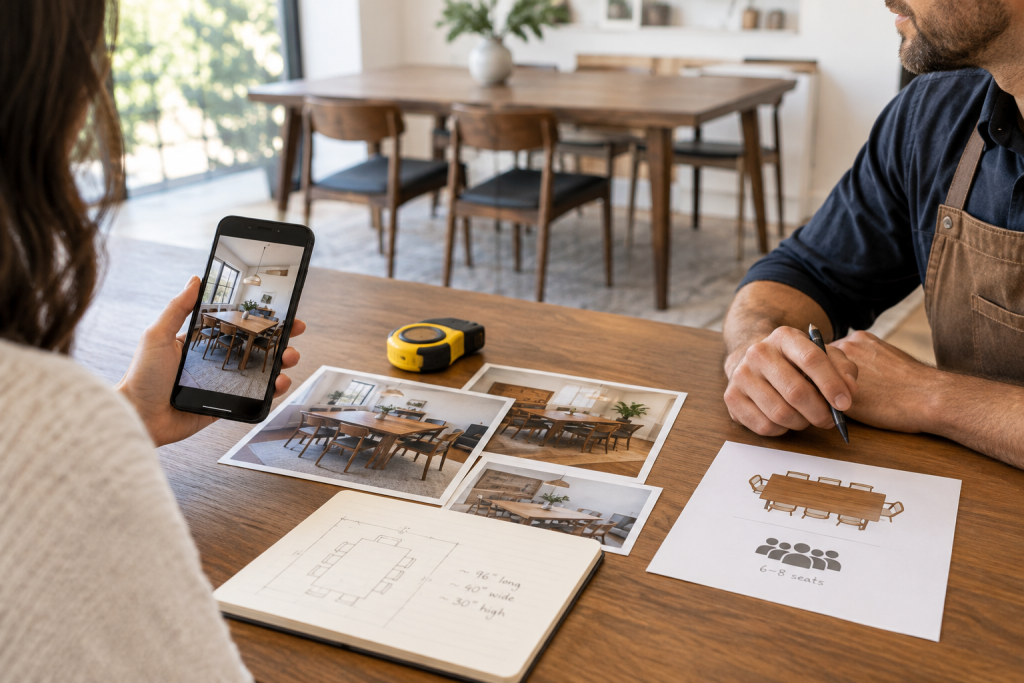
Wondering what to send a custom table maker for a quote? The good news is that you do not need finished furniture plans, an architectural drawing or a decision about every last detail. A few useful pieces of information can start a productive conversation.
For a custom dining table in Park City, Deer Valley, Heber City, Midway, Kamas, Hideout or another Wasatch Back community, the most helpful starting materials are room photos, approximate dimensions, your seating goal, examples of tables you like and any access or personalization details you already know.
1. Send clear photos of the room
Room photos help a table maker understand the setting in a way that a measurement alone cannot. Take several photos from different corners of the dining area, including views toward nearby walls, windows, doors and connecting rooms.
Try to include:
- The full dining area, not just the spot where the table will sit
- Doorways, hallways and stair openings near the room
- Existing chairs, benches, lighting or rugs you plan to keep
- Nearby cabinets, islands, fireplaces or other fixed features
- A wider view showing how people enter and move through the space
Photos do not need to be professionally taken. A phone camera is fine. Straightforward and well-lit is more useful than polished. If the property is a second home or vacation property, current photos can make remote planning much easier.
2. Include approximate room and table dimensions
Early measurements do not have to be perfect. The goal is to establish a sensible range for the table, not to produce a final installation drawing.
Send the room’s approximate length and width, along with the dimensions of any fixed items that affect placement. Note the width of nearby doors and the clearance around them. If you already have a table in the room, include its length, width and how it feels in use.
It is also useful to mention the space you would like to preserve around the table for chairs and walking paths. The design conversation can then consider table size, seating requirements, chair width and base placement together. A table that fits on paper may feel cramped once chairs are pulled out, so circulation matters.
If you would like more structure, use this dining room measurement guide as a starting point. Approximate information is still welcome if you are at the beginning of the process.
3. Explain how many people you want to seat
Tell the maker how many people you expect to seat comfortably on an ordinary day and how many you would like to accommodate for larger gatherings. Those may be different numbers, and both are helpful.
For example, you might need a table for regular family meals but want additional capacity when guests visit a ski home or vacation property. You may also want to use end seating, a bench or a combination of chairs and benches. Mention whether children, wider dining chairs or armchairs will be part of the plan.
There is no single correct table length for a guest count. Chair width, table shape, base design and room clearance all affect the result. The purpose of sharing your seating goal is to give the maker a practical target to work from rather than forcing you to choose a length in isolation.
4. Share photos of tables and rooms you like
Inspiration images are often more useful than style labels. Words such as “rustic,” “modern” or “mountain style” can mean very different things to different people. A few specific images show what you mean.
You can send examples of:
- Tabletops with a grain pattern, edge profile or amount of character you prefer
- Farmhouse, trestle, modern hardwood or live-edge silhouettes
- Base styles you like—or base styles you want to avoid
- Light, medium or dark wood tones
- Rooms with a similar scale or interior design direction
- Tables that show the amount of visual detail you want
These images are references, not a demand to duplicate someone else’s table. They help narrow the conversation around proportions, wood character, finish, base style and overall mood. Park City Tables’ custom table gallery can also be used for design inspiration; gallery images should be treated as examples of possible directions, not as a list of current inventory.
5. Say what you already know about wood and finish
You do not need to know which species you want before requesting a quote. If you have a preference, include it. If not, describe the look you are trying to achieve and ask for options.
The Standard Collection includes Douglas fir, alder, maple, white oak and black walnut, with established farmhouse, trestle and modern hardwood designs. These choices can provide a simpler, more predictable starting point. A project involving a live-edge slab, epoxy, an unusual dimension or distinctive material may fit better within the Specialty Collection.
When discussing wood, consider the color, grain, character and relationship to the rest of the room. You might prefer a lighter, quieter appearance, or you might want prominent natural character to become part of the room’s focal point. There is no universally best wood; the right choice depends on appearance, design, practical preferences and the rest of your specifications. You can review the available custom table wood options before the consultation.
6. Mention the table shape, base and seating details
If you have a preferred shape, say so. If you are unsure, provide the room dimensions and explain how you expect people to use the table. Rectangular tables are common for larger dining rooms, while other shapes may suit a particular layout or circulation pattern.
Base style deserves attention, especially for a large table. A farmhouse, trestle, four-leg or other base arrangement can change where chairs fit, how much legroom is available and where people sit comfortably. Tell the maker whether end seating is important, whether you want a matching bench and whether you have a design preference.
Park City Tables can also discuss custom benches and table bases as part of the overall design rather than treating them as an afterthought.
7. Include access notes before the table is built
A large table has to reach the room, not merely fit inside it. Share anything you know about the delivery route, including narrow doors, tight turns, stairs, elevators, low clearances or a room that can only be reached through a particular entrance.
If the home is being remodeled, access may change before delivery. Note that as well. For a second home, a property manager, contractor or other authorized contact may be able to provide current photos and measurements.
Early access information helps the design conversation account for practical delivery and setup. Park City Tables offers table delivery and setup in Park City, Deer Valley, Heber City, Midway and surrounding Wasatch Back communities. Delivery planning can include bringing the table into the intended room, assembling or attaching the base when needed, leveling and final placement.
8. Add personalization ideas, even if they are still rough
If you are considering engraving, mention the idea early. You do not need final artwork or perfect wording to begin. A family name, meaningful date, coordinates, monogram, company logo, short inscription or custom artwork may be possible on qualifying builds.
Placement can affect the design. Depending on the table, engraving may be considered for the tabletop, apron, base, end, underside or another suitable location. Share what the detail means to you and whether you want it to be subtle or easy to see.
You can learn more about custom table engraving, including the types of personalization that may be available. Simple custom engraving currently starts at $195, while more complex engraving and artwork are quoted individually.
9. State your timing and budget range if you have one
Timing information helps determine which design path makes sense. Park City Tables currently advertises an estimated target of approximately four weeks for Standard Collection tables and approximately eight weeks for Specialty Collection projects. These are estimates, not guaranteed completion dates, and material selection and project requirements can affect the schedule.
A budget range is also useful if you have one, but it is not required to begin. Standard table pricing currently begins around $2,195 for a 6-foot Douglas fir configuration. Final pricing depends on dimensions, wood, width, base, finish, delivery requirements and options. Specialty projects may cost more depending on the slab, epoxy, premium wood, unusual size and other details. See the current custom table pricing information for additional context.
A simple message you can send
If you are not sure how to organize your first email, keep it practical. You could include:
- The property location and whether it is a primary home, second home, vacation property or business
- Room photos and approximate room dimensions
- The number of people you want to seat regularly and for larger gatherings
- Your preferred table length, if you have one
- Photos or links showing styles, woods, finishes or bases you like
- Any bench, engraving or personalization ideas
- Door, stair, elevator and hallway information that may affect access
- Your preferred timing and any budget guidance you are comfortable sharing
That is enough to get moving. The consultation can help narrow the size, wood, style, base, finish and options as the design becomes clearer.
Ready to start the conversation?
Send a room photo, approximate dimensions, the number of people you would like to seat and a few examples of tables you like. You do not need completed plans. To request a custom table quote from Park City Tables, call 435-200-4982 or use the contact form at ParkCityTables.com.